

Endocrine, Neurological
This resource provides current and comprehensive health care information for school health nurses. Related procedures, instructional videos and downloadable skills checklists can be searched by selecting the [More Information] button at the bottom of this web page.
Overview
Epilepsy vs. Seizures:
Seizures are sudden surges of abnormal and excessive electrical activity occurring in the brain and can affect how the person appears or acts. Epilepsy is a brain disorder that causes recurring, unprovoked seizures. An individual may be diagnosed with epilepsy if they have two unprovoked seizures more than 24 hours apart or one unprovoked seizure with a high risk of more. Not all seizures are caused by epilepsy. Seizures may relate to a brain injury, a family trait, or fever but often the cause is completely unknown. The word “epilepsy” simply means the same thing as “seizure disorders” (Epilepsy Foundation, 2023g).
Graphic: Seizure Algorithm
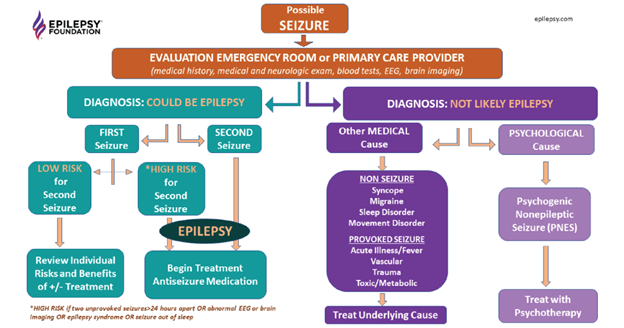
Source: Epilepsy Foundation, 2023h
Types of Seizures:
The International League Against Epilepsy (ILAE) revised the classifications of seizures in 2017. The image below outlines the new classification system. Seizures are classified into three different types: focal onset, generalized onset, and unknown onset.
Image: ILAE 2017 Classification of Seizure Types Basic Version1.
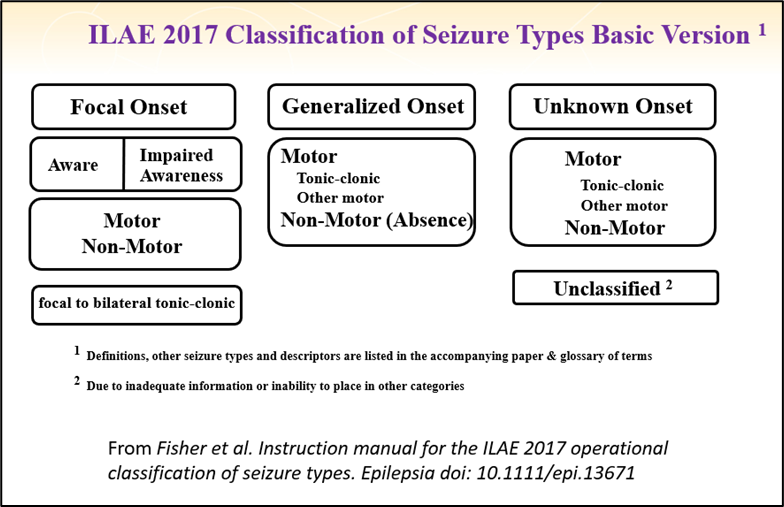
Source: Fisher and Saul, 2017
The ILAE reclassification further categorizes seizures based on level of awareness and motor involvement.
Graphic: Classification of Seizures with Descriptions
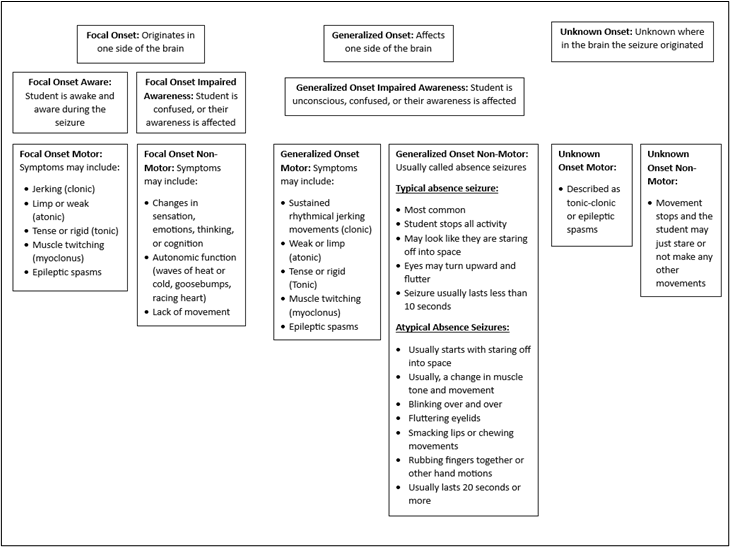
Sources: Epilepsy Foundation, 2023a; Epilepsy Foundation, 2023i; Fisher and Saul, 2017
Phases of a Seizure: There are four phases associated with a seizure. The Early Ictal, also known as the Aura and the Ictal phase are considered part of the seizure. The prodromal phase can be an early warning to the student that they may experience a seizure.
- Prodromal phase: The phase before the seizure. It is defined as the period from when early symptoms begin to before the diagnosable symptoms begin. Common symptoms associated with the prodromal phase include confusion, anxiety, irritability, headache, tremor, and anger or other mood disturbances. About 20% of people with epilepsy experience the prodromal phase (Cure Epilepsy, 2023; Schachter, 2022).
- Early Ictal (The Aura): For those who experience an early ictal stage, which is about 65% of people with epilepsy, their symptoms will vary based on the types of seizures they experience. The symptoms can include:
- Bitter, acidic taste
- Deja Vu
- Dizziness
- Flickering vision
- Hallucinations
- Head, arm, or leg pain
- Jamais vu (feeling of unfamiliarity with a person, place, or thing despite having already experienced it)
- Nausea/stomachache
- Numbness
- Out-of-body experience
- Ringing or buzzing sounds
- Strange, offensive smells
- Strong feelings of joy, sadness, fear, or anger
- Subtle arm or leg twitching
- Tingling
- Vision loss or blurring (Cure Epilepsy, 2023; Schachter, 2022).
- Ictal Phase: The phase most people would identify as a seizure. The symptoms of the seizure vary based on the types of seizure an individual experiences.
- Post-Ictal phase: This phase is the recovery period after the seizure. Some individuals with epilepsy recover quickly while others could take minutes, hours, or days to fully recover. The length of the phase depends on the seizure type, severity, and region of the brain affected (Cure Epilepsy, 2023; Schachter, 2022).
Average Length of Seizures:
Depending on the types of seizures a student has, there may be an expected amount of time that the seizure may last.
Table: Average Length of Seizures
| Type of Seizure | Average Length of Time Seizure Will Last |
| Focal Aware | 1 to 3 minutes |
| Focal Impaired Awareness | 1 to 3 minutes |
| Generalized Non-Motor (Absence) | Less than 20 seconds |
| Generalized Motor (Tonic Clonic) | 1 to 3 minutes |
Source: Epilepsy Foundation, 2022c
Status Epilepticus:
Status Epilepticus is defined as any seizure lasting longer than 5 minutes or when seizures occur very close together and the student does not recover consciousness between the seizures (Epilepsy Foundation, 2023d). Seizures lasting longer than 30 minutes are dangerous and increase the student’s risk of death (Epilepsy Foundation, 2023d) which is why early recognition and prompt action is vital. Students who experience status epilepticus should receive their emergency seizure medications and then undergo prompt medical treatment in an emergency department.
Convulsive Status Epilepticus: Is a tonic-clonic seizure lasting more than 5 minutes or when a student has repeated tonic-clonic seizures without recovering consciousness for a period of longer than 5 minutes. Convulsive Status Epilepticus is a medical emergency and requires prompt treatment in the emergency department (Epilepsy Foundation, 2023d).
Nonconvulsive Status Epilepticus: Is a term used to describe a “single or repeated absence or focal impaired awareness seizure during which the student is not able to respond but is not displaying any movement or shaking of the body for longer than 10 minutes. This can be as convulsive and then become nonconvulsive because of persistent seizures” (Epilepsy Foundation, 2023d). This type of seizure also requires prompt treatment in the emergency department (Epilepsy Foundation, 2023d).
Treatments for Epilepsy:
There are several treatments for epilepsy, including medications, surgery, and dietary therapy.
Anti-Seizure Medications: There are a large number of anti-seizure medications that have varying mechanisms of action to suppress seizure activity. The anti-seizure medications do not treat the underlying cause of epilepsy, they alter the electrical activity in the neurons and alter chemical transmissions between neurons (Epilepsy Foundation, 2022c). The Epilepsy Foundation has developed a resource that lists the anti-seizure medications. The school nurse should review the list of medications that the student takes and educate themselves about the mechanism of action and possible side effects associated with the medication. Many anti-seizure medications can cause fatigue, dizziness, unsteadiness, blurry vision, stomach upset, headaches, redacted resistance to cold, memory and thinking problems, weight loss or weight gain (depending on the medication). Another important concern that the school nurse should be aware of is that students who are prescribed generic anti-seizure medications should use the same manufacturer for each refill. Switching generic manufacturers could result in different amounts of active drug in each pill. This could result in variation in blood levels and could lead to breakthrough seizures or side effects. The school nurse should inform the family to let the school nurse know when there is a change in medication so the school staff and school nurse can monitor the student more closely for seizures, changes in their seizure pattern, and/or for potential side effects (Epilepsy Foundation, 2023e).
Emergency Seizure Medications: There are also a number of emergency seizure medications that have various routes of administration, including buccal, nasal, and rectal. The school nurse should review the student’s Seizure Action Plan (SAP) and health care provider’s order to ascertain what emergency seizure medication is prescribed for the student and familiarize themselves with the medication’s mechanism of action, route, and potential side effects or adverse reactions. See the Medication section for more information on emergency seizure medications.
Additional Medical Treatments:
Not all students with epilepsy will respond to seizure medications and other treatments may be prescribed including, but not limited to, epilepsy surgery, neuromodulation or the use of implanted seizure devices including a vagus nerve stimulation (VNS), or dietary therapies such as the Ketogenic Diet.
Vagus Nerve Stimulation: VNS may be considered a treatment option for students with epilepsy who have tried two or more anti-seizure medications without adequate control or for patients who have not responded to the anti-seizure medications and cannot have brain surgery. VNS is a treatment that is used in conjunction with anti-seizure medications. It typically does not result in the student being seizure free. It has shown success in reducing the number, length, and severity of seizures and can reduce the amount of time it takes to recover after a seizure. For students who have auras or warnings before their seizure, the stimulation of the VNS with a magnet when the warning occurs can shorten or stop the seizure (American Association of Neurological Surgeons, 2023).
A VNS sends regular, small pulses of electrical energy to the brain via the vagus nerve in the neck. The device can be programmed to send stimulation at regular intervals and when periods of increased heart rate are seen. The stimulator (also known as a generator) is implanted under the skin in the left side of the chest. A thin wire is wrapped around the left vagus nerve in the neck and goes under the skin and connects to the stimulator. If a student is aware that they are going to have a seizure or someone sees the student seizing, they can swipe the magnet over the generator to send an extra burst of stimulation to the brain. This could help decrease the severity of the seizure or stop the seizure. (Epilepsy Foundation, 2023h; Epilepsy Foundation, 2018c).
The Kennedy Krieger Institute’s Specialized Health Needs Interagency Collaboration has developed a Vagus Nerve Stimulation Magnet Procedural Guide.
Comorbidities:
Having epilepsy increases a student’s risk of having a mood or learning disorder. In addition, students may suffer from headaches, ulcers, and other physical conditions. The likelihood of having a co-morbidity is impacted by several factors, including the frequency of seizures, types and amounts of medication the student is taking, and the age when the student’s seizures began.
Depression and Anxiety: Depression is the most common comorbidity. It is estimated that at least 25% of children with epilepsy have depression and/or anxiety (LaGrant, et al., 2020) and up to 20% of children with epilepsy have thought about suicide (Sirven & Shafer, 2014). The school nurse should monitor the student for any signs of depression or other mental health concerns and collaborate with the student’s parents, teachers, and student support professionals to provide the necessary case management and support, if needed.
Attention Deficit Hyperactivity Disorder (ADHD): ADHD is a common health condition in children with epilepsy. About one-fourth to one-third of children with epilepsy show signs of ADHD. Children with epilepsy also frequently have learning problems that may impact their academic success. Students with epilepsy should be evaluated for a 504 Plan or Individualized Education Plan (IEP). More information can be found in the Legal Issues section.
Delegation
There are several factors for the school nurse to consider when deciding whether to delegate this procedure to unlicensed assistive personnel (UAP). This section will provide a list of questions that the school nurse should answer to assist them in determining whether it is appropriate and safe to delegate the procedure. It is also important to remember that the questions related to delegation need to be answered for every individual student. The decision to delegate is based on circumstances related to the student, the nurse, the UAP, and the situation. Missouri law allows for the delegation of the administration of emergency seizure medication to unlicensed assistive personnel (UAP).
Questions to Ask to inform Safe Delegation: The delegation questions below are based on the American Nurses Association’s Decision Tree for Delegation by Registered Nurses (ANA, 2012) and the National Association of School Nurses’ Emergency Medication Administration Delegation Decision Tree (NASN, 2020a).
- Has the nurse performed an initial student assessment to determine their needs?
The school nurse should not delegate the procedure to an Unlicensed Assistive Personnel (UAP) until they have completed the initial assessment. - Does the school district policy, the school nurse’s job description, and the UAP’s job description allow the delegation of administering emergency seizure medications?
Although the Missouri Nurse Practice Act allows for registered nurses to delegate administration of emergency seizure medications to school staff, the school nurse should ensure that the district does not have policies that prohibit or limit the school nurse’s ability to delegate. Additionally, the school nurse should review their own and the UAP’s job description to confirm that it is appropriate to delegate this procedure. - Is the school nurse competent to perform this procedure or does the school nurse need to acquire some knowledge or skills to be competent in this procedure?
If the school nurse does not have the knowledge or skills or does not feel comfortable performing this procedure, they should not delegate this procedure to a UAP. The school nurse must first acquire the necessary knowledge and skill to perform this procedure competently before they can delegate it to someone else. - Does the student have any other health conditions that make their overall health status unstable?
The student’s health condition should be stable so that when the emergency seizure medication administration is completed by following a set procedure or protocol the student is not at undue risk. - Are the results of the emergency seizure medication administration or the magnet activation of the vagus nerve stimulator (VNS) reasonably predictable?
If the results of the emergency seizure medication administration or magnet activation of VNS are not predictable then this procedure should not be delegated. - Does the UAP have the appropriate knowledge, skills, abilities, and willingness to perform the procedure?
All these factors need to be considered. Although a UAP may be competent to perform the procedure they may not be willing to do so and in that situation another UAP should be identified and trained. The registered nurse must retain responsibility for the procedure until training is complete. - Is there a procedure and/or protocol in place for this procedure?
A delegated nursing procedure must have an established sequence of steps that the UAP can follow. These steps should have a predictable outcome. The steps should be outlined in a written procedure or protocol. If the written procedure/protocol has not been developed, the school nurse should retain responsibility for the procedure until the procedure/protocol is in place. - Is the school nurse able to provide supervision to the UAP (direct or indirect depending on the situation)?
If the school nurse is not able to provide supervision, then the procedure should not be delegated. The school nurse will need to assess the situation to determine if direct or indirect supervision is required. The school nurse may also need to reassess the situation if the environment changes, for example, if the procedure is going to be performed during a time that the school nurse is not contracted to provide nursing services (i.e., over the weekend, during the summer, or if the school nurse is part-time).
Delegation Decision Tree and Delegation (NASN)
The Decision to Delegate:
There may be times when the school nurse and school administrator have conflicting opinions on the delegation of a procedure to a UAP. The school nurse may feel that delegation is not appropriate or the administrator may want the school nurse to delegate a procedure to an UAP that the school nurse feels is not competent. In these situations the school nurse may need to educate the administrator that the school nurse has a professional and legal responsibility to determine if delegation of a nursing procedure is appropriate and safe (ANA, 2012). See Fact Sheet for School Administrators, Families, and School Personnel: Nursing Delegation Requires the School Nurse and Navigating Delegation in the School Setting (pdf) to assist school nurses communication with the school administration.
School Environment
Seizure Safe School:
Ensuring that school staff have the knowledge, ability, and skills to recognize and respond effectively when a student is having a seizure is essential. The Epilepsy Foundation (2022a) advocates that every school implement the following components as part of a seizure safe school:
- Ensuring all school staff are prepared to recognize and respond appropriately and efficiently to a student during a seizure
- Mandating that Seizure Action Plans (SAP) are made a part of the student’s file and made available to school personnel and volunteers responsible for the student
- Ensuring the student has access to necessary and life-saving medication
- Educating and training students about epilepsy and first aid response
Recognition and Response to Seizure: Will’s Law requires school nurses or their designee to train school staff, including school employees working with school-sponsored programs outside of the regular school day, every two years on the care of students with epilepsy and seizure disorders. It is recommended by the Epilepsy Foundation and the NASN that the training include a common understanding of seizures, understand the first aid steps that should be undertaken when a student is experiencing a seizure, recognize what would constitute a seizure emergency and understand steps that they could take to help support a student living with epilepsy (Epilepsy Foundation Programs Department, 2019; NASN, 2019a). Will’s Law requires that the training be:
- Offered online or in-person.
- Be approved by the Department of Health and Senior Services.
- Be provided by a reputable, local, Missouri-based health care or nonprofit organization that supports the welfare of individuals with epilepsy or seizure disorders, such as the Epilepsy Foundation of Missouri and Kansas.
Access to Necessary and Life-Saving Medication: Not only is it imperative that the student have access to their emergency seizure medication at school in the event of a seizure, but the medication also needs to be accessible in a timely manner and the school administration and school nurse must ensure that there is always a trained individual available to administer the medication. This requires the school nurse to plan for where the medication will be stored during the school day and in the event of an unplanned shelter-in-place, lockdown, or school evacuation, and off-site excursions such as field trips. For more information on emergency seizure medication see the Medication section.
Educating Students: Students should be given age-appropriate information about epilepsy and seizures and receive guidance on how to talk with their friend or classmate about their epilepsy. Students should also be taught what to do if they witness a student having a seizure at school (American Academy of Pediatrics (AAP), 2022).
Exposure to Seizure Triggers in the School Environment:
Some students with epilepsy may have seizure triggers, such as strobe or flashing lights, that could be present in the school environment. It is important that the school nurse and the student’s teachers be aware of these triggers and make the appropriate accommodations to assist the student in avoiding them.
Students
An important first step when caring for a student who is diagnosed with epilepsy is to complete a health history and physical assessment, preferably with the student and their parents present.
Health History Questions:
- Medical conditions
- Medications
- Allergies
- Previous hospitalizations
- Insurance coverage
- Health care provider(s) name and contact information
- Preferred hospital, if applicable
- Seizure specific information:
- When student was diagnosed with epilepsy
- Seizure type
- Length of seizure
- Frequency of seizures
- Description of seizure
- Seizure triggers
- Any warnings, auras, and/or behavior changes that occur before a seizure
- Date of last seizure
- Any recent changes in student’s seizure pattern
- How does the student react after seizure?
- How does illness impact the student’s seizures?
- Has the student been hospitalized for continuous seizures?
- Does the student have a Vagus Nerve Stimulator?
- If yes, is the student able to use the magnet themselves?
- Where is the magnet located/stored?
- How should the magnet be swiped?
- How many times should the use of the magnet be repeated?
(Epilepsy Foundation, n.d.-b; Missouri Department of Health and Senior Services, 2021; NASN, 2019a)
The Epilepsy Foundation has developed a Questionnaire for a Parent of a Student with Seizures.
Assessment Questions: The school nurse may want to consider asking the student and their parents/guardians the following additional questions:
- Does the student have a Seizure Action Plan (EAP) or Individualized Emergency Health Care Plan (IEHC)?
- What constitutes an emergency for the student?
- What basic first aid procedures should be taken when the student has a seizure?
- How long does it take for the student to return to baseline after the seizure?
- Will the student need to leave the classroom after a seizure?
- Is the student incontinent after a seizure, if yes, how should we plan for this?
- When and how do you want the school to let you know that your child has had a seizure?
- How does this health condition impact the student’s daily life?
- How often does the student miss school due to their health condition(s)?
- Tell me about your friends.
- How often do you spend time with them?
- Has the student shared information about their seizures with their friends/peers?
- Does the student or parent have any concerns about their student’s health condition?
- What challenges does the student face in managing their health condition?
- Do you feel the student has been sufficiently supported by school staff in managing their health condition?
- Who has the student been going to when they need help?
- How often does the student have bad feelings about coming to school because they are worried/afraid/embarrassed about something (peers, assignments, teacher)?
- Has the student had to change any of their social activities because of their health condition?
- Has the student ever been picked on or bullied?
- Does the student have a 504 Plan or Individualized Education Program (IEP)?
- Would the student benefit from evaluations or assessments in any of the following areas: physical therapy, occupational therapy, speech and language therapy, assistive technology, adapted physical education, functional behavior, psychology, hearing and vision?
- Would the student benefit from additional academic support and/or modified education (i.e., copies of notes, extra time, reduced workload, simplified instructions, alternative formats for presentation of material, 504/IEP)?
- Does the student have an Individualized Health Care Plan (IHCP)?
- Is there a need for a specific plan for this student’s individual needs if there is a crisis in the building?
- How is the student transported to and from school?
- Does the student attend before or after school care?
- Does the student participate in school-sponsored clubs or athletics?
(Llorens, McKee, & Dempsey, 2020; Missouri Department of Health and Senior Services, 2021; NASN, 2019a).
Transition Planning:
The school nurse should assess the student’s current and desired level of independence to determine what goals should be established for the student. Additionally, the school nurse should discuss with the student and family what steps have been initiated related to transition planning. The school nurse should consider including goals related to self-management and decision-making skills in the student’s Individualized Health Care Plan (IHCP) (NASN, 2019c) and consider how those goals can be expanded upon each year to support independence, if appropriate.
The American Epilepsy Society recommends that students with epilepsy begin working on their transition plan from pediatric care to adult care at around ages 10 to 13 with the goal of transitioning being to “empower young adults living with epilepsy to self-manage their medical care, prescriptions, and diet” (AAP, 2023).
Some suggested activities that students with epilepsy could do to begin taking some responsibility for their health condition would be to:
- Keep track of their medication adherence
- Log their seizures
- Sign in for appointments
- Bring a list of medications to health care provider appointments
- Report seizures to health care provider
- Answer health care provider’s questions
- Ask the health care provider questions (Epilepsy Foundation of Texas, 2023).
For students with cognitive disabilities, it may not be possible for the student to become independent in all aspects of managing their health care. Transitioning planning for students with cognitive disabilities should be tailored to the student’s level of developmental abilities and in collaboration with the student’s parents/guardians and health care team (AAP, 2023).
Got Transition has developed Transition Readiness Assessment for Youth and a Transition Readiness Assessment for Parents/Caregivers and the Child Neurology Foundation has developed the Self-Care Assessment for Youth and Young Adults and the Self-Care Assessment for Parents and Caregivers. The National Association of School Nurses has developed Supporting Students with Epilepsy: A Transition Toolkit for School Nurses.
The American Epilepsy Society has developed Transitions From Pediatric to Adult Epilepsy Care worksheets for children with disabilities and for those without. Although these worksheets were developed for health care providers, it could be beneficial for the school nurse to be aware of the education that is being provided to the student and their family and the skills that the student is working on so the school nurse can work in collaboration with the health care team and family.
Transportation:
It is important for the school nurse to determine how the student is transported to and from school. If the student is transported on the school bus the school nurse may be required to educate school bus drivers about epilepsy and train them on how to respond, provide seizure first aid, and administer the emergency seizure medication. The school nurse should confer with the school administrator to determine who is responsible to provide the training as school bus drivers who are employed by an outside agency may receive their training through their employer.
Communication
The school nurse should discuss with the student and their family the best way(s) to communicate with them. Does the parents/guardian have a preference (i.e., email, text, telephone call)? Do the parents prefer to have the communications sent to both parents or is there a parent who manages the communication with the school nurse? Periodic communication with the student’s parents/guardians is important to share any updates or concerns but it is especially important for the school nurse to communicate with the parents and health care provider when a seizure occurs at school, both to “make them aware of a lowered seizure threshold and to reassess the adequacy of standing medication doses” (Hartman, Devore, et al., 2016, p. 2).
The school nurse may want to consider having the parents/guardians complete a Health Insurance Portability and Accountability Act (HIPAA) compliant medical release form to facilitate communication with the student’s health care team. Although HIPAA does not require parental consent to allow the school nurse to discuss the student’s treatment plan, such as medications and nursing procedures, with the student’s health care provider, having a signed consent form would undoubtedly make the process go smoother for all involved parties (U.S. Department of Health and Human Services & U.S. Department of Education, 2008).
FERPA HIPAA Consent Sample (NASN)
Medication
Emergency Seizure Medication:
There have been a number of new formulations of seizure medications in the past several years which have resulted in easier, more convenient routes of medication administration, since previously, the only medication available for the school setting was rectal diazepam. The NASN encourages school nurses to advocate for the least restrictive medication choice (buccal or nasal rather than rectal) (NASN, 2019a). With the expanded options for emergency seizure medications the school nurse must ensure that they are educated and trained on how to administer these medications and if they are delegating the medication administration, that they have trained the UAP and verified their knowledge, abilities, and skills. Currently, in the school setting, emergency seizure medications are typically prescribed to be administered buccally, nasally, and rectally. The medications currently approved by the Food and Drug Administration (FDA) for out-of-hospital use for treatment of acute repetitive seizures or clusters are:
- Diastat® (diazepam rectal gel),
- Nayzilam® (midazolam nasal spray), and
- Valtoco® (diazepam nasal spray) (Hoerth & Shafer, 2019).
There are also some “off-label” non-FDA approved formulations of emergency seizure medications. These include:
- Clonazepam oral disintegrating tablet,
- Lorazepam oral solution, and
- Midazolam oral solution.
These medications are typically administered buccally or orally. If the student’s health care provider has prescribed a non-FDA approved formulation of emergency seizure medication, the school nurse should follow-up with the health care provider and pharmacist for more information. Liquid lorazepam requires refrigeration so the school nurse will want to consider storage and access during an emergency (Hartman, Devore, et al., 2016).
Health Care Provider Order:
Frequently, the health care provider’s order for emergency seizure medication administration will be included in the student’s Seizure Action Plan (see the Documentation section for more information on Seizure Action Plans). If the student does not have a Seizure Action Plan, at a minimum, the following information should be included in the health care provider’s order for their emergency seizure medication administration:
- Name of the student
- Date of birth
- Name of medication
- Dose
- Route
- Time of administration
- Reason for administration
- i.e., cluster seizures, # of seizures, or length of seizure
- Care that should be provided after the administration of the medication
- When 911 or Emergency Medical Services (EMS) should be called
- When to contact the health care provider
Field Trips
Special consideration needs to be given when planning for a field trip. One of the most important considerations is the storage and location of the medication and along with ensuring that a school staff member who is trained in seizure first aid and emergency seizure medication administration will be accompanying the student on the field trip. In addition, school staff should also review potential exposure to seizure triggers (such as bright light strobes or patterns) and brainstorm prevention strategies.
It is important to note that the Section 504 of the Rehabilitation Act does not allow for a student with a disability to be excluded from a field trip due to their disability.
The school nurse and school personnel should consider the following when planning for a field trip:
- Confirm that students on the field trip who have diagnosed seizures have all the necessary items for the field trip including:
- Health care provider order/Seizure Action Plan
- Emergency Seizure Medication
- Emergency Contact Information
- Ensure that the Seizure Action Plan is up-to-date and reviewed to determine if any revisions are needed due to the field trip.
- Plan to have emergency plans stored with the medication during the field trip. Consider what steps will need to be taken to ensure health plans remain confidential.
- Determine where emergency medication will be stored keeping in mind temperature stability, accessibility, and safety.
- Emergency medication should not be left unattended on the school bus or with a school staff/volunteer who is not with the student.
- Determine how medications administered on the field trip will be documented.
- Develop a plan to obtain additional emergency medication, if needed.
- Determine locations of emergency departments and hospitals along the route for the field trip and in the vicinity of the final field trip destination.
- Determine if any additional staff are needed on the field trip to meet the health care needs of the students.
- Identify whether school staff who will be accompanying students on the field trip have the necessary training, education, and competence to perform any emergency procedures such as emergency seizure medication administration.
- Consider that there may be areas where cellphone reception is limited or not available and plan accordingly.
- If the field trip will be occurring out of the state:
- Review the states’ Nurse Practice Acts to confirm that the administration of emergency seizure medication can be delegated to an UAP in that state.
- Determine if the states traveled through or visited are a part of the Nurse Licensure Compact.
- If the field trip will be occurring out of the country the school nurse should discuss with school administration any applicable laws to determine what additional steps may be needed. In addition, the U.S. Embassy can provide information on points of contact for destination countries (Erwin, Clark, & Mercer, 2014; NASN, 2019b; Wisconsin Department of Public Instruction, 2019).
The Field Trip planning checklist above was developed based on the National Association of School Nurses’ Emergency Medication Toolkit (NASN, 2020a). Resources for field trip planning: NASN Resource: Field Trip Preparation Checklist
Documentation
The medical management of student’s epilepsy in the school setting will require the school nurse to acquire and complete numerous forms of documentation.
Health Care Provider Order: Frequently the health care provider’s order for emergency seizure medication is written as a Seizure Action Plan (SAP) If the student does not have a SAP then the school nurse will need a health care provider’s order for the medication administration. See the Medication section for more information.
Seizure Action Plan (SAP): Will’s Law requires the school nurse to develop a Individualized Emergency Health Care Plan (IEHC) which is also known as a Seizure Action Plan (SAP). The plan “describes the procedures and specific directions a person will take in an emergency” (Missouri Department of Health and Senior Services, n.d., p. 1). The SAP should provide instructions for when the student should be transported to the emergency department since not all students with epilepsy may require further evaluation or care in the emergency department as “recurrent transportation to an emergency department is neither feasible nor desirable” (Hartman, Devore, et al., 2016, p.3).
The Epilepsy Foundation, the Child Neurology Foundation, Epilepsy Alliance America, and the Missouri Department of Health and Senior Services have all developed SAP templates.
It is recommended that the SAP contain the following information:
- Student name
- Date of birth
- Parent/Guardian name and phone number
- Emergency contact name and phone number
- Type of seizures
- Triggers
- Symptoms that may indicate that a seizure may be coming and any treatment that may be needed
- Average length of seizure
- How often seizures occur
- What happens during a seizure (actions or behaviors the student exhibits)
- Actions to take during the seizure
- First aid to provide during the seizure
- When to call 911 or Emergency Medical Services (EMS)
- When emergency seizure medication should be administered
- Name of emergency seizure medication
- Dose of emergency seizure medication
- Route of administration of emergency seizure medication
- If more than one dose of emergency seizure medication should be given, and if so, when
- Care to be provided after the seizure
- Adverse reactions to emergency seizure medication to monitor for
- Special instructions for first responders or emergency department
- Daily seizure medications
- Important medical history
- Allergies
- Epilepsy surgery
- Any implanted devices (i.e. Vagus Nerve Stimulator (VNS), Responsive Neurostimulation System (RNS), or Deep Brain Neurostimulator Device (DBS))
- Diet therapy (i.e., Ketogenic, Low Gymcemic, Modified Atkins)
- Health care provider(s) names and contact information
(Child Neurology Foundation, n.d.; Epilepsy Foundation, 2023b; Seizure Action Plan Coalition, 2023)
Documentation of a Seizure: Since the symptoms associated with a seizure are important in the diagnosis and classification of seizures, it is important to be attentive and document as many details about the seizure, including the student’s symptoms and behavior prior to, during, and after the seizure.
What to Observe for During a Seizure:
- What did you see or hear first?
- Was the student able to tell you if they didn’t feel well?
- What happened during the seizure?
- Was the student awake, confused, or unconscious?
- What part of the face and body were involved?
- Did you notice any changes in speech or behavior?
- How long did the seizure last?
- After the seizure did the student quickly return to normal?
- After the seizure was the student tired, confused, or have any additional symptoms?
(Epilepsy Foundation, 2019, Epilepsy Foundation, 2022b)
The Epilepsy Foundation has developed Tips for Seizure Observation and Recording and a Seizure Reporting Form which would be a helpful tool to store with the student’s emergency seizure medication and in the student’s classroom.
Parent/Guardian Authorization: In addition to the health care provider’s order, the school nurse will also need written authorization from the parents/guardians to administer the student’s emergency seizure medication. The SAP templates developed by the Child Neurology Foundation and the Epilepsy Foundation include a section for parent authorization. If the parent authorization is not included or the health care provider just provides an order for the emergency seizure medication then the school nurse will want to document the parent/guardian authorization on a separate document.
Procedures and Medication Administration: All medication administration and epilepsy-related procedures (i.e., VNS use) will need to be documented, whether they are performed by the school nurse or a UAP. Many times the medication administration and procedures are documented in the student’s health record. The school nurse will also want to ensure that medications being administered, or procedures being performed during field trips, before or after school, and/or during any school-sponsored activities are being documented.
Staff Competency Validation: If the procedures or medication administration is delegated to a UAP the school nurse should document that the UAPs knowledge, abilities, and skills have been assessed. Many times these factors are documented on a skills competency checklist (see Skill Competency Checklists). There should be a place on the skills competency checklist for the school nurse and UAP to sign to indicate that they feel competent and are willing to perform the procedure. Once the procedure has been delegated the school nurse is responsible for periodic evaluation of the UAP and their competency. The school nurse must determine how often the supervision is needed. After the school nurse has re-evaluated the UAP’s competency, they should document the date of the evaluation (Shannon & Kubelka, 2013; Selekman & Ness, 2019). The school nurse should organize the competency documentation in a way that easily allows them to determine when subsequent evaluation and documentation of competency is needed. For more information on delegation see the Delegation section.
Individualized Health Care Plan (IHCP): IHCPs should outline the plan of care for the student, including but not limited to:
- Avoidance of seizure triggers/antecedents.
- Anti-epileptic drug side effects, such as drowsiness, fatigue, nausea, anorexia, headaches, hyperactivity, somnolence, gastrointestinal upset, and rash.
- Use (including parameters, instructions, and delegation/training, if applicable) of VNS, as outlined in health care provider’s orders.
- Dietary modifications, as indicated by health care provider’s orders, and mechanism to assist student adherence to diet.
- Recording of seizure occurrence and/or seizure-like activity in an observation log (NASN, 2019a, p. 10).
- Actions the school nurse will take to support the student’s educational attainment.
- The education and training that will be provided to school personnel.
- The development of Emergency Action Plans, including steps to be taken in case of an evacuation.
- And the accompanying expected outcomes for each of the nursing interventions (NASN, 2020b).
Prior to completing the IHCP, the school nurse should complete a health history and physical assessment of the student. For more information on health history see the Student section.
Section 504 Plan: Students with epilepsy may qualify for a Section 504 Plan since their health condition may impact a major life activity (learning). If the student has been identified as qualifying for a 504 Plan, the school nurse may be involved in identifying appropriate accommodations and writing the plan. Once developed, the school nurse will want to frequently review, update, and document in the 504 Plan (NASN, 2020b). For more information on Section 504 Plans see Legal Issues section.
Individualized Education Program (IEP): If a student with epilepsy has an IEP where “related services” include nursing services, the school nurse will want to ensure they provide and document the related services in the student’s education record, whether this is paper or electronic. This documentation is necessary for the school to validate that they are providing the services that the student has been determined to be eligible for under the Individuals with Disabilities Education Act (IDEA) (Galemore & Sheetz, 2015). For more information on IEPs see Legal Issues section.
Emergency Preparedness
Shelter-in-Place and Other Emergency Events:
In addition to ensuring that students with epilepsy have a Seizure Action Plan (see Documentation section) and that all school staff have been educated on the signs and symptoms of a seizure and know how to respond (see School Environment section); the school nurse must also plan for other potential emergencies such as lockdown, extreme weather events, evacuations, and shelter-in-place events. To develop plans to address these possible emergencies the school nurse would want to collaborate with other school staff and administrators. The school nurse should determine if the student with epilepsy has any physical and cognitive disabilities that could impact their ability to independently respond in an emergency or to follow commands, the school nurse and team will want to incorporate all the student’s individual factors into the planning. The emergency preparedness plan should address the following:
- Location of emergency seizure medications.
- Additional accommodations that may be required during an emergency (i.e., extra staff to help support the student’s needs).
- Equipment needed to assist with evacuation if the child has limited mobility.
(Center for Inclusive Child Care, 2020; Federal Emergency Management Agency, 2009)
The Seizure Action Plan should also address the potential adverse effects that could occur after emergency seizure medications have been administered along with the actions that school staff and/or the school nurse should take if the student were to experience an adverse effect. “Adverse effects of all seizure rescue medications include decreased respirations, oversedation, and cardiopulmonary instability, which may vary in severity depending on the duration of the seizure, dose of the seizure rescue medication, and interactions with other medicines” (Hartman, et al., 2016, p. 3).
For more information on emergency planning see Missouri School Boards’ Association’s Emergency Planning Guide for Students and Staff with Special and Functional Needs within Schools.
Legal Issues
There is currently one Missouri State Statute that relates to management of epilepsy in the school setting. It is: 167.625. Will’s law — definitions — epilepsy or seizure disorder, individualized emergency health care plan, requirements — immunity from liability, when.
Section 504 Plan:
Students with epilepsy may qualify for a Section 504 Plan. Section 504 of the Rehabilitation Act of 1973 as amended through the Americans with Disabilities Amendment Act (ADAA) in 2008 ensures that students who have disabilities have access to a free and appropriate public education (FAPE) (U.S. Department of Education, 2023). FAPE provides a student with a physical or mental impairment that impacts one or more major life activities (including learning) with related services and accommodations in the general education classroom (U.S. Department of Education, 2023; NASN, 2023). If the student does not have a 504 Plan the school nurse should determine if an evaluation is indicated (see Students section for questions to ask student and family to determine if 504 or IEP evaluation is indicated). If it is determined that the student qualifies for a Section 504 Plan, the school nurse may want to consider the appropriateness of the following accommodations:
- School staff shall identify a person and a back-up person to be trained to administer the student’s emergency seizure medication to the student in accordance with the health care provider’s orders, as stated in the attached Seizure Action Plan. A trained staff member shall be available to perform this task at all times during which the student is at school or attending a school-related activity or event.
- School staff shall ensure that if the student has a seizure and needs to sleep or rest afterwards or otherwise needs to rest during the school day, he or she will have the opportunity to do so in a safe, supervised, comfortable setting. The setting does not have to be the school nurse’s office, and supervision does not have to be provided by the school nurse, unless physician orders so require.
- The student will participate in all field trips, extracurricular activities, and school-related activities and events (such as sports, clubs, enrichment programs, and overnight trips) without restriction and with all the accommodations and modifications, including necessary assistance and supervision by identified school or contract personnel, set out in this Plan. The student’s parent/guardian will not be required to accompany him/her on field trips or any of these other listed events or activities.
- (If the student is on the ketogenic diet) The student shall have access to needed food and liquids as required during the school day in order to maintain the protocol of the ketogenic diet.
- (If the student has a vagus nerve stimulator (VNS)) School staff who work with the student shall be trained regarding the VNS and how it works.
(Epilepsy Foundation, n.d.-a)
The Epilepsy Foundation of Northern California has developed a model Section 504 Plan that could be used as a template and guide for the development of a Section 504 Plan.
Individualized Education Program (IEP):
Students with epilepsy may have an intellectual disability or significant developmental delay that qualifies them for an IEP. An IEP is developed by a multidisciplinary special education team. The IEP outlines the plans for special education services for the student who has a qualifying disability that interferes with learning. The IEP plan identifies what services and accommodations are needed to support the student’s education needs (NASN, 2020b). Many interventions provided as part of the IEP plan are “related services”, which include school nursing services and school health services (U.S. Department of Education, 2017).
Resources
- Epilepsy Foundation Seizure First Aid Poster
- Epilepsy Foundation Seizure Medication List
- Epilepsy Foundation Summary of Anti-Seizure Medications
- Got Transition
- Missouri Department of Health and Senior Services Will’s Law Overview
- Missouri Department of Health and Senior Services Medication Administration in Missouri Schools
- Missouri Medication Administration in Missouri Schools: Guidelines for Developing Training and Practice
References
American Academy of Pediatrics. (2022). Supporting children and youth with epilepsy at school.
American Academy of Pediatrics. (2023, September 8). Epilepsy resources for health care professionals: Health care transition.
American Association of Neurological Surgeons. (2023). Vagus nerve stimulation.
American Nurses Association. (2012). Principles of delegation.
Center for Disease Control and Prevention (CDC). (2020, September 30). Types of seizures.
Center for Inclusive Child Care. (2020). Tip sheets. Emergency planning for children with disabilities.
Child Neurology Foundation. (n.d.). Seizure action plan for.
Cure Epilepsy. (2023). Phases of seizures.
Epilepsy Foundation. (n.d.-a). Model section 504 plan for a student with epilepsy.
Epilepsy Foundation. (n.d.-b). Questionnaire for parent of a student with seizures.
Epilepsy Foundation. (2018a, September). Dietary therapy to treat seizures and epilepsy.
Epilepsy Foundation. (2018b, September). Surgery for epilepsy.
Epilepsy Foundation. (2018c). Vagus nerve stimulation (VNS therapy®).
Epilepsy Foundation. (2019). Tips for seizure observation and recording.
Epilepsy Foundation. (2022a, March 25). Advocacy: Seizure safe schools.
Epilepsy Foundation. (2022b, March 31). Seizure training for school nurses: Caring for students (on demand)- v2.0a.
Epilepsy Foundation. (2023a). Absence Seizures.
Epilepsy Foundation. (2023b, March). Seizure action plan (SAP).
Epilepsy Foundation. (2023c). Seizure devices.
Epilepsy Foundation. (2023d). Status epilepticus.
Epilepsy Foundation. (2023e). Summary of anti-seizure medications.
Epilepsy Foundation. (2023f). Types of seizures.
Epilepsy Foundation. (2023g). Understanding seizures.
Epilepsy Foundation. (2023h). Vagus nerve stimulation (VNS) therapy.
Epilepsy Foundation. (2023i). What is epilepsy?
Epilepsy Foundation Programs Department. (2019). Seizure training for school personnel.
Epilepsy Foundation of Texas. (2023). Teens with epilepsy (for adults). Helping in youth transitioning.
Erwin, K., Clark, S., & Mercer, S.E. (2014). Providing health services for children with special health care needs on out-of-state field trips. NASN School Nurse, 29(2), 84-8. doi: 10.1177/1942602X13517005
Federal Emergency Management Agency. (2009). Evacuating the special needs population.
Fisher, R.S. and Saul, M. (2017). The 2017 ILAE classification of seizures (Powerpoint).
Fisher, R. S., Cross, J. H., D’Souza, C., French, J. A., Haut, S. R., Higurashi, N., Hirsch, E., Jansen, F. E., Lagae, L., Moshé, S. L., Peltola, J., Roulet Perez, E., Scheffer, I. E., Schulze-Bonhage, A., Somerville, E., Sperling, M., Yacubian, E. M., & Zuberi, S. M. (2017). Instruction manual for the ILAE 2017 operational classification of seizure types. Epilepsia, 58(4), 531–542.
Galemore & Sheetz. (2015). IEP, IHP, and section 504 primer for new school nurses. NASN School Nurse, (Print), 30(2), 85–88. https://doi.org/10.1177/1942602X14565462
Hartman, A. L., Devore, C. D., Section on Neurology, American Academy of Pediatrics, Council on School Health, American Academy of Pediatrics, & Doerrer, S. C. (2016). Rescue Medicine for Epilepsy in Education Settings. Pediatrics, 137(1), 10.1542/peds. 2015-3876.
Hoerth, M, & Shafer, P.O. (2019, April 14). Seizure rescue therapies.
LaGrant, B., Marquis, B. O., Berg, A. T., & Grinspan, Z. M. (2020). Depression and anxiety in children with epilepsy and other chronic health conditions: National estimates of prevalence and risk factors. Epilepsy & behavior : E&B, 103(Pt A), 106828.
Llorens, A., McKee, S., & Dempsey, A.G.). (2020). In A.G. Dempsey (Ed.). Pediatric health conditions in schools. (pp. 26-27). New York, NY: Oxford Press.
Missouri Department of Health and Senior Services. (n.d.). Will’s law overview.
Missouri Department of Health and Senior Services. (2021). SN chat®. School nurse chronic health assessment tool.
National Association of School Nurses. (2019a). School nursing evidence-based practice clinical guideline: Students with seizures and epilepsy. Silver Spring, MD: Author.
National Association of School Nurses. (2019b). School-sponsored trips -The role of the school nurse (Position Statement). Silver Spring, MD: Author.
National Association of School Nurses. (2019c). Transition planning for students with healthcare needs (Position Statement). Silver Spring, MD: Author.
National Association of School Nurses. (2020a). Emergency medication toolkit.
National Association of School Nurses. (2020b). Understanding student health and education plans.
Schachter, S.C. (2022, February 4). What happens during a seizure?
Seizure Action Plan Coalition. (2023). What should a SAP contain?
Selekman, J. & Ness, M. (2019). Students with chronic conditions. In J. Selekman, R.A. Shannon, C.F. Yonkaitis, (Eds.). School nursing, a comprehensive text (3rd ed., p 493). Philadelphia PA.: F. A. Davis Co.
Shannon, R. A., & Kubelka, S. (2013). Reducing the risks of delegation: use of procedure skills checklists for unlicensed assistive personnel in schools, Part 2. NASN School Nurse (Print), 28(5), 222–226.
Sirven, J.I. & Shafer, P.O. (2014, March 19). Related conditions.
U.S. Department of Education. (2017, May 2). Sec. 300.34 related services.
U.S. Department of Education. (2023). Frequently asked questions about Section 504 and the education of children with disabilities.
U.S. Department of Health and Human Services & U.S. Department of Education. (2008). Joint guidance on the application of the Family Educational Rights and Privacy Act (FERPA) the Health Insurance Portability and Accountability Act of 1996 (HIPAA) to student health records.
Will’s law — definitions — epilepsy or seizure disorder, individualized emergency health care plan, requirements — immunity from liability, when. Missouri Revised Statute: 167.625 RSmo. (2022).
Wisconsin Department of Public Instruction. (2019). Meeting student health needs while on field trips. Tool kit for Wisconsin schools.
Reviewers
Renee Falkner, BSN, RN
School Nurse Supervision Specialist | Therapylog
Katherine Park, DNP, RN, NCSN
Nationally Certified School Nurse, Pierremont Elementary
Adjunct Professor, Maryville University School of Nursing
Last updated 4/18/2025
More Information