

Cardiovascular
This resource provides current and comprehensive health care information for school health nurses. Related procedures, instructional videos and downloadable skills checklists can be searched by selecting the [More Information] button at the bottom of this web page.
Overview
Central venous access devices (CVAD) provide access to the central venous system via the superior vena cava (SVC) or inferior vena cava (IVC). CVADs can be used for short- (typically less than 30 days) or long-term therapy (typically greater than 30 days) and are used to administer fluids, medications, and nutrition (Kennedy Krieger Institute, 2020).
Table: Types of Central Venous Devices
| Type of Catheter | Description | Nursing Considerations |
| Peripherally inserted central catheter (PICC) | Can be used for short (<30 days) or long-term (>30 days) therapy Single or double lumen catheters | Requires semipermeable dressing over the exit site at all times. Dressings must be changed regularly and whenever the bandage becomes wet or loose. Dressings are typically changed every 7 days. Must keep exit site dry. Protrudes outside the body. Can be damaged by sharp objects. Can be pulled out. May affect body image. Water sports may be restricted |
| Tunneled central venous catheters | Used for long-term IV therapy (>30 days)A subcutaneous cuff secures the catheter into place and prevents the migration of organisms when ingrown. The cuff may be felt as a small bump under the skin. Single or double lumen catheters. Used for long term parenteral nutrition, bone marrow transplant, and chemotherapy. Common types: Hickman or Broviac Catheter | Requires semipermeable dressing over the exit site at all times. Dressings must be changed regularly and whenever the bandage becomes wet or loose. Dressings are typically changed every 7 days. Must keep exit site dry. Protrudes outside the body. Important that the catheter be looped and secured at all times. Can be damaged by sharp objects. Can be pulled out. May affect body image. Water sports may be restricted. Some children may benefit from a physical barrier covering the catheter, such as close-fitting clothing or a commercially available central line wrap |
| Implanted port | Used for long-term therapy (>30 days)Single or double lumen. Accessed by inserting a needle through the intact skin. Common types: BardPort®, PowerPort®, or Port-A-Cath. Used for chemotherapy. Ports are not indicated for parenteral nutrition | Would be highly unusual for school nurse to have to access student’s port in the school setting. Should check with health care provider if student has any activity restrictions. Catheter tip may migrate internally, especially if the student “plays” with the port site (Twiddler Syndrome) (Anderson & Herring, 2024, p. 709). “Twiddlers Syndrome occurs when the port has been moved under the skin because of trauma or “twiddling” by the child. If you notice the port is easy to move under the skin or swelling has occurred, do not use the port” (Kennedy Krieger Institute, 2020, p. 1). |
Sources: Anderson & Herring, 2024; Memorial Sloan Kettering Cancer Center, 2023; St. Jude Children’s Research Hospital, 2023; The Joint Commission, n.d.; University of Wisconsin Hospitals and Clinics Authority, 2022
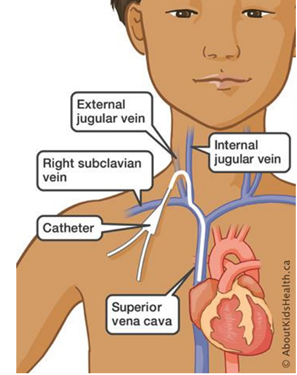
Indications for Use:
Students may require a CVL for a variety of health conditions. Some of the more common reasons include:
- Short-Bowel Syndrome: occurs when the small intestine is shortened or damaged and cannot absorb enough nutrients from the foods the child eats to maintain health.
- Childhood cancers: Numerous childhood cancers may result in the need for a CVL for treatments such as chemotherapy, immunotherapy, and stem cell transplant.
- Cystic fibrosis: Students with cystic fibrosis may have a CVL for antibiotic therapy during an exacerbation.
- Sickle Cell Disease: Children with sickle cell disease may require a CVL due to difficulty with peripheral venous access due to scarring and frequent access.
- Metabolic Disorders: Similar to short-bowel syndrome, children with some metabolic disorders may lack the ability to consume or absorb certain nutrients so may require a CVL for the administration of parenteral nutrition.
(Ann & Robert H. Lurie Children’s Hospital of Chicago, 2016; Putigna & Solenberger, 2022; Ullman, et al., 2020).
Central Venous Access Device Use in the School Setting:
It would be a very rare occurrence for a school nurse to administer medications or flushes via a central venous line (CVL) in the school setting. Additionally, it is not recommended to complete a CVL dressing change at school given the need for aseptic technique, the amount of time it takes to complete the dressing change, and the need for a second trained person to assist (Kennedy Krieger Institute, n.d.).
Unless a nurse trained in central venous catheter (CVC) care is with the child or at the school, any issues with the line should be immediately directed to the parent with the supplies in the kit only acting as a temporizing measure if needed. In general, no one at school should be manipulating the CVC (Wendel, et al., 2021, p. 477).
Porter et al. (2019, p. 737) states,
The school nurse is not responsible for accessing a PICC or CVAD port or administering medications through the venous access device during the school day. Schools should evaluate whether a student with a central line who is receiving long-term continuous therapy needs a personal nurse to care for him or her.
Even if the school nurse will not be administering medications via the CVL or changing the dressing, the school nurse should still assess the CVL site for signs and symptoms of infection, including redness, swelling, drainage, pain the at the exit site, and/or presence of fever in the student (Toothaker & Cook, 2018). The assessment findings should be documented in the student’s health care record and any concerns should be reported to the parents/guardians and health care provider.
Delegation
It is important to note that pursuant to Title 20—DEPARTMENT OF COMMERCE AND INSURANCE Division 2200—State Board of Nursing Chapter 6—Intravenous Infusion Treatment Administration: Qualified practical nurses shall only perform venous access and intravenous (IV) infusion treatment modalities according to the specific provisions of section 335.016, RSMo, 20 CSR 2200-5.010, and this chapter. A qualified practical nurse shall only perform such activities under the direction and supervision of a registered professional nurse or a person licensed by a state regulatory board to prescribe medications and intravenous infusion treatments.
There are a number of factors for the school nurse to consider when deciding whether to delegate procedures related to central venous lines to a licensed practical nurse (LPN). This section will provide a list of questions that the school nurse should answer to assist them in determining whether it is appropriate and safe to delegate the procedure. It is also important to remember that the questions related to delegation need to be answered for every individual student. The decision to delegate procedures related to CVLs is based on circumstances related to the student, the nurse, the LPN, and the situation. It is important to note that procedures related to CVLs are very uncommon in the school setting so significant thought and planning should be undertaken if these procedures are being delegated to LPNs.
Questions to Ask to Inform Safe Delegation:The delegation questions below are based on the American Nurses Association’s Decision Tree for Delegation by Registered Nurses (ANA, 2012).
- Has the school nurse performed an initial assessment of the student to determine their needs?
The school nurse should not delegate the procedure to an LPN until they have completed the initial assessment. - Does the school district policy, the school nurse’s job description, and the LPN’s job description allow procedures related to CVLs to be delegated?
Although the Missouri Nurse Practice Act allows for registered nurses to delegate central venous line procedures, the district may have policies that prohibit or limit the school nurse’s ability to delegate. Additionally, the school nurse’s and LPN’s job descriptions may restrict delegation as well. - Is the school nurse competent to perform this procedure or does the school nurse need to acquire some knowledge or skills to be competent in this procedure?
If the school nurse is not competent or does not feel comfortable performing this procedure they should not delegate this procedure to an LPN. The school nurse must first acquire the necessary knowledge and skill to perform this procedure competently before they can delegate it to someone else. - Is the student’s condition stable? Is this an established central venous line or was it recently placed? How predictable are the outcomes of the procedure?
A school nurse should not delegate medication administration or care of the CVL to an LPN if the student has a newly placed central venous line. The outcomes are not predictable and thus the school nurse should perform the procedures until the student’s condition has stabilized. - Does the procedure require an initial assessment to be performed during the procedure?If an initial assessment is required for the procedure to be performed, the procedure should not be delegated.
- Does the LPN have the appropriate knowledge, skills, abilities, and willingness to perform the procedure?
All these factors need to be considered. Although an LPN may be competent to perform the procedure they may not be willing to do so and in that situation another LPN (if available) should be identified and trained. If another LPN is not available, the registered nurse must retain responsibility for the procedure. - Is there a procedure and/or protocol in place for this procedure?
A delegated nursing procedure must have an established sequence of steps that the LPN can follow. These steps should have a predictable outcome. The steps should be outlined in a written procedure or protocol. If the written procedure/protocol has not been developed, the school nurse should retain responsibility for the procedure until the procedure/protocol is in place. - Is the school nurse able to provide supervision to the LPN (direct or indirect depending on the situation)?
If the school nurse is not able to provide supervision, then the procedure should not be delegated. The school nurse will need to assess the situation to determine if direct or indirect supervision is required. The school nurse may also need to reassess the situation if the environment changes, for example, if the procedure is going to be performed during a time that the school nurse is not contracted to provide nursing services (i.e., over the weekend, during the summer, or if the school nurse is part-time). - Is the student ready to assume some responsibility for the procedure?
The school nurse should resume responsibility for the procedure since the school nurse is the only one who can initiate teaching. The school nurse would also want to observe the student performing the procedure to ensure that the student is competent. Once the school nurse has determined that the student is competent and can safely perform the procedure independently, they can delegate the supervision of the student to an LPN. If at a future date the school nurse is needed to teach the student additional skills, the school nurse would again need to resume responsibility for the procedure until the time in which the school nurse determined the student to be competent.
The Decision to Delegate:
There may be times when the school nurse and school administrator have conflicting opinions on the delegation of a procedure to an LPN. The school nurse may feel that delegation is not appropriate or the administrator may want the school nurse to delegate a procedure to an LPN that the school nurse feels is not competent. In these situations the school nurse may need to educate the administrator that the school nurse has a professional and legal responsibility to determine if delegation of a nursing procedure is appropriate and safe (ANA, 2012). See Fact Sheet for School Administrators, Families, and School Personnel: Nursing Delegation Requires the School Nurse and Navigating Delegation in the School Setting (pdf) to assist school nurses communication with the school administration.
School Environment
Space and Time to Perform the Procedure:
This procedure requires additional resources including a second person to assist with the procedure, 30 minutes of uninterrupted time, and the ability to perform this procedure using Aseptic non touch technique (ANTT®). If the school nurse does not have the capability to perform this procedure then the school nurse should discuss with the student’s parents/guardians and health care provider to arrange a different plan.
Physical Education and Recess:
The school nurse should review the health care provider’s order to see if there are any activity restrictions associated with the student’s central venous line and/or underlying health condition that may require precautions during physical education class or at recess. Many students with CVLs will be advised to not participate in contact sports and use an abdominal binder, ace wrap, or tight-fitting shirt to keep the line and tubes close to the body (Wendel, et al., 2021).
Education of Peers and School Staff:
The school nurse may want to discuss with the student and their family about their desire for the student’s peers and school staff to be made aware and educated about the student’s underlying health condition and/or need for a central venous line. Depending on the student and family’s wishes, educating peers may help alleviate endless questions and help teach peers on how to be supportive and inclusive.
Students
Health History Questions: The school nurse may want to ask the student and their parents/guardians the following questions:
- Current health conditions
- Medications
- Allergies
- Previous hospitalizations and surgeries
- Most recent hospitalization
- Location of central venous device
- Exit site of central venous device
- Date of surgical placement
- Device specific information
- Manufacturer name
- Model/Lot number
- Catheter length
- Catheter size (french)
- Number of lumens
- Home health agency
- Insurance coverage
- Health care provider(s) name and contact information
- Preferred hospital, if applicable
Assessment Questions: The school nurse may want to consider asking the student and their parents/guardians the following questions:
- How does this health condition impact the student’s daily life?
- How often does the student miss school due to their health condition(s)?
- Tell me about your friends.
- How often do you spend time with them?
- Has the student shared information about their health condition(s) with their friends/peers?
- Does the student require activity precautions to prevent injury?
- Does the student have specific hydration requirements?
- Does the classroom environment support the student’s needs (i.e., desk/seating options)?
- Does the student and/or their parents/guardian have any concerns related to the student’s health condition?
- Do you feel the student has been sufficiently supported by the school staff in managing their health condition?
- Who has the student been going to when they need help?
- How often does the student have bad feelings about coming to school because they are worried/afraid/embarrassed about something (peers, assignments, teacher)?
- What challenges does the student face in dealing with their health condition?
- Has the student had to change any of their social activities because of their CVL or underlying health condition?
- Has the student ever been picked on or bullied?
- Does the student attend before or after school care?
- Does the student participate in school-sponsored clubs or athletics?
- Would the student benefit from evaluations or assessments in any of the following areas: physical therapy, occupational therapy, speech and language therapy, assistive technology, adapted physical education, functional behavior, psychology, hearing and vision?
- Would the student benefit from additional academic support and/or modified education (i.e., copies of notes, extra time, reduced workload, simplified instructions, alternative formats for presentation of material, 504/IEP)?
- Does the student have an Individualized Health Care Plan (IHCP)?
- Is there a need for a specific plan for this student’s individual needs if there is a crisis in the building?
- If shelter-in-place were required or the school day needed to be unexpectedly extended, what additional supplies, equipment, and health care provider orders would be needed?
- How is the student transported to and from school?
(Clarke, Embury, & Yssel, 2014; Llorens, McKee, & Dempsey, 2020).
Communication
It is important for the school nurse to discuss with the student and their family the best way(s) to communicate with them. Does the parents/guardian have a preference (i.e., email, text, telephone call)? Do the parents prefer to have the communications sent to both parents or is there a parent who manages the communication with the school nurse?
The school nurse may want to consider having the parents/guardians complete a Health Insurance Portability and Accountability Act (HIPAA) compliant medical release form to facilitate communication with the student’s health care team. Although HIPAA does not require parental consent to allow the school nurse to discuss the student’s treatment plan, such as medications and nursing procedures, with the student’s health care provider, having a signed consent form would undoubtedly make the process go smoother for all involved parties (U.S. Department of Health and Human Services & U.S. Department of Education, 2008).
FERPA HIPAA Consent Sample (NASN)
Medication
Many times children have a CVL due to medication administration needs such as chemotherapy. It would be a very rare occurrence that the school nurse would be administering medication via the student’s CVL in the school setting. If at all possible, the school nurse should work with the student, their parents/guardian, and health care provider to find a time, outside of school hours, for the medication to be administered or have a personal nurse accompany them at school and administer the medication. If this is not possible, the school nurse should ensure that they have the proper training and education to administer the medication in the school setting.
Health Care Provider Order:
In addition to training and education, the school nurse will also need an order from the health care provider. For students who require medication administration via CVL the following information should be included in the health care provider’s order:
- Name of the student
- Date of birth
- Name of medication
- Dose
- Route
- Time of administration
- Reason for administration
- Amount of saline flush to be administered pre-medication administration
- Amount of saline flush to be administered post-medication administration
- Amount of heparin flush to be administered, if ordered
Delegation of Medication Administration:
Given that medication administration via a CVL is a complex procedure, the school nurse needs to consider if an LPN has the appropriate knowledge, abilities, skills, and willingness to administer the medication. See the Delegation and Legal Issues That May Impact This Health Condition sections for more information. The National Association of School Nurses has developed a Medication Administration Delegation Checklist that school nurses may find helpful when making decisions regarding delegating medication administration.
Field Trips
Field trips and other out of school activities can add a layer of complexity to the care of a student with a CVL. Considerable planning with the student, their parents/guardians, and the student’s health care team would need to occur prior to having a student with a CVL attend a field trip. It would not be advisable to perform any CVL-related procedures while on the field trip thusthe field trip planning questions below do not include questions about performing medication administration or a dressing change on the field trip and only relate to safety planning.
It is important to note that the Section 504 of the Rehabilitation Act does not allow for a student with a disability to be excluded from a field trip due to their disability.
There are several variables that the school nurse will want to consider and plan for, including:
- Where will the emergency kit be stored?
The student’s emergency kit should be with them at all times. The emergency kit should not be left on the bus but should be with the student at all times. If an adult is responsible for carrying the emergency kit, that adult should be with the student at all times. - Are there any activities that will be occurring on the field trip that could create a safety issue related to the student’s CVL?
i.e., exposure to water or unclean areas, potential for injury, etc. If yes, then a meeting should occur to discuss whether the field trip should or can take place. - How will the student’s Emergency Action Plan be modified on the field trip?
The school nurse will want to consider any potential emergencies that may arise on the field trip and develop plans on how to address them. The school nurse would want to determine where hospitals are in relation to the field trip route or destination and identify the average Emergency Medical Services (EMS) response time. This information should then be used to make any necessary modifications to the Emergency Action Plan (NASN, 2019). - Who on the field trip will be responsible for providing emergency care to the student if needed?
The school nurse needs to ensure that someone is trained to provide any needed emergency care to the student while on the field trip. - Is the field trip occurring out of state or out of the country?
Field trips that occur out of the student’s home state will require some additional planning. If the school nurse will be accompanying the student on the field trip, they will want to determine if the state(s) that will be traveled through or visited are a part of the Nurse Licensure Compact. If the school nurse will not be accompanying the student but instead will be delegating the procedures, the school nurse will want to review the other state’s nurse practice acts and associated rules and regulations to determine if the procedure can be delegated to an LPN in that state. For out of the country field trips, the school nurse should discuss with school administration any applicable laws to determine what additional steps may be needed. In addition, the U.S. Embassy can provide information on points of contact for destination countries. The school will also want to connect with the student’s parents/guardians regarding informing the Transportation Security Administration about the student’s health needs.
(Erwin, Clark, & Mercer, 2014; NASN, 2019; Wisconsin Department of Public Instruction, 2019)
Documentation
Emergency Action Plan: Students with CVLs will require planning related to possible emergencies that may occur at school including dislodgement or breakage of the CVL and/or development of an air embolism. The school nurse could develop an Emergency Action Plan and incorporate the emergency steps, including the necessary training of school staff, into the Individualized Health Care Plan. If the student has a Section 504 Plan or IEP, these emergency steps and planning should be documented in those plans as well. See the Emergency Preparedness section for more information.
Parent/Guardian Authorization: In addition to the health care provider’s order, the school nurse will also need written authorization from the parents/guardians to perform any CVL-related procedures at school. The authorization form can be a separate document that just the parents sign, or a document can be developed that combines the health care provider’s order and parent authorization in one form.
Procedures and Medication Administration: All medication administration and CVL-related procedures will need to be documented, whether they are performed by the school nurse or the LPN. Many times the medication administration and procedures are documented in the student’s health record. The school nurse will also want to ensure that medications being administered, or procedures being performed during field trips, before or after school, and/or during any school-sponsored activities are being documented. If the student has an agency nurse then the school nurse will want to document their communication and planning with the agency nurse in the student’s health record.
Staff Competency Validation for Emergency Response: The school nurse would not be delegating medication administration or dressing change procedures to UAPs but they should be training and educating UAPs on how to recognize and respond in case of an emergency relating to the student’s CVL. The school nurse should document that the UAPs knowledge, abilities, and skills have been assessed. Many times these factors are documented on a skills competency checklist. There should be a place on the skills competency checklist for the school nurse and UAP to sign to indicate that they feel competent and are willing to perform the emergency steps. The school nurse is responsible for periodic evaluation of the UAP and their competency. The school nurse must determine how often the supervision is needed. After the school nurse has re-evaluated the UAP’s competency, they should document the date of the evaluation (Shannon & Kubelka, 2013; Selekman & Ness, 2019). The school nurse should organize the competency documentation in a way that easily allows them to determine when subsequent evaluation and documentation of competency is needed. For more information on delegation see the Delegation section.
LPN Competency Validation: If the school nurse is delegating any CVL-related procedures to a LPN, then the nurse should document that the LPNs knowledge, abilities, and skills have been assessed. Many times these factors are documented on a skills competency checklist (see Skill Competency Checklists). There should be a place on the skills competency checklist for the school nurse and UAP to sign to indicate that they feel competent and are willing to perform the procedure. Once the procedure has been delegated the school nurse is responsible for periodic evaluation of the UAP and their competency. The school nurse must determine how often the supervision is needed. After the school nurse has re-evaluated the UAP’s competency, they should document the date of the evaluation (Shannon & Kubelka, 2013; Selekman & Ness, 2019). The school nurse should organize the competency documentation in a way that easily allows them to determine when subsequent evaluation and documentation of competency is needed. For more information on delegation see the Delegation section.
Individualized Health Care Plan (IHCP): IHCPs are typically developed for students with underlying health care conditions that require daily nursing interventions or if their health condition could result in an emergent situation. IHCP development should be prioritized for students who require significant health services at school, have a medical diagnosis that may result in a health crisis, and/or students with health conditions addressed in a Section 504 Accommodation Plan or an Individualized Educational Program (Yonkaitis & Shannon, 2019). If the student has underlying health conditions that warrant an IHCP, the IHCP may need to be updated to include information and planning related to their CVL. The student’s IHCP should include the following:
- Type of central venous device placed
- The timing for dressing changes
- Reporting of any fever, chills, or site changes such as redness, swelling, or drainage
- Application of standard precautions
- The school nurse should review general safety guidelines for all personnel who have regular contact with the student and ensure the ready availability of supplies such as dressings and/or spare clamps (Toothaker & Cook, 2018).
Section 504 Plan: Depending on how long the student will have a CVL, they may qualify for a 504 Plan. If the student will have a CVL for less than 6 months, the student would not qualify for a Section 504 Plan. For more information on 504 Plans see the Legal Issues section.
Emergency Preparedness
All students who have a CVL should have an emergency action plan and emergency kit. The emergency kit should be with the student at all times. School staff who have regular interaction with the student should be trained on what to do if the CVL were to become dislodged or if the student were to complain of chest pain or shortness of breath.
Emergency Kit:
The student should have an emergency kit on them at all times. The emergency kit should include:
- Chlorhexidine kit
- Catheter cap
- Stat lock
- Sterile gauze
- Medical tape
- Clean gloves
- Smooth edge clamp or hemostat
- Flushing supplies:
- Alcohol wipes
- 10 ml syringes
- Heparin flush
If the student’s central venous catheter becomes dislodged, save all the parts and send along with the student so the parts can be examined by the health care provider (UC Davis Children’s Hospital, 2015).
Emergency Action Plan:
A student with a CVL should have an Emergency Action Plan. The Emergency Action Plan should include:
- The student’s name
- Date of birth
- Medical condition
- Health care provider’s contact information
- Parent/guardian’s contact information
- Signs of an emergency
- Many times written as student complaints or observations
- Actions that should be taken for student complaints or observations
- Parent, school nurse, and health care provider’s signature
The Kennedy Krieger Institute has developed an Emergency Action Plan for a Vascular Access Device.
Shelter-in-Place and Other Emergency Events:
Based on the student’s underlying health condition(s) additional plans for other potential emergencies such as lockdown, extreme weather events, evacuations, and shelter-in-place events. To develop plans to address these possible emergencies the school nurse would want to collaborate with other school staff and administrators.
For more information on emergency planning see Missouri School Boards’ Association’s Emergency Planning Guide for Students and Staff with Special and Functional Needs within Schools.
Legal Issues
Pursuant to Title 20—DEPARTMENT OF COMMERCE AND INSURANCE Division 2200—State Board of Nursing Chapter 6—Intravenous Infusion Treatment Administration: Qualified practical nurses shall only perform venous access and intravenous (IV) infusion treatment modalities according to the specific provisions of section 335.016, RSMo, 20 CSR 2200-5.010, and this chapter. A qualified practical nurse shall only perform such activities under the direction and supervision of a registered professional nurse or a person licensed by a state regulatory board to prescribe medications and intravenous infusion treatments.
Section 504 Plan:
Section 504 of the Rehabilitation Act of 1973 as amended through the Americans with Disabilities Amendment Act (ADAA) in 2008 ensures that students who have disabilities have access to a free and appropriate public education (FAPE) (U.S. Department of Education, 2023). FAPE provides a student with a physical or mental impairment that impacts one or more major life activities with related services and accommodations in the general education classroom (U.S. Department of Education, 2023; NASN, 2023). If the student is expected to have a CVL for less than 6 months, the student would not qualify for a Section 504 Plan. Congress clarified that an individual is not “regarded as” an individual with a disability if the impairment is transitory and minor. A transitory impairment is an impairment with an actual or expected duration of 6 months or less (U.S. Department of Education, 2023). If the student requiring a CVL has underlying health conditions they may qualify for or already have an existing Section 504 Plan. If the student has underlying health conditions and does not have a 504 Plan the school nurse should determine if an evaluation is indicated (see Students section for questions to ask student and family to determine if 504 or IEP evaluation is indicated).
Resources
American Nurses Association. (2012). Principles of delegation.
Anderson, C.E. & Herring, R. A. (2024). Pediatric nursing interventions and skills. In Hockenberry, Duffy, & Gibbs (Eds). Wong’s nursing care of infants and children (12th Ed., pp. 669-738).
Ann & Robert H. Lurie Children’s Hospital of Chicago. (2016, April 8). Hematology/Oncology/Stem Cell Transplant (HOT) central venous catheter.
CHEO. (2019). Central venous lines [photo].
Clarke, L.S., Embury, D.C., and Yssel, N. (2014). Supporting students with disabilities during school crisis. A teacher’s guide. Teaching Exceptional Children, 46(6), 169-78. doi/10.1177/0040059914534616
Erwin, K., Clark, S., & Mercer, S.E. (2014). Providing health services for children with special health care needs on out-of-state field trips. NASN School Nurse, 29(2), 84-8. doi: 10.1177/1942602X13517005
Galemore & Sheetz. (2015). IEP, IHP, and section 504 primer for new school nurses. NASN School Nurse, (Print), 30(2), 85–88.
Intravenous infusion treatment administration. Missouri Code of State Regulations. Rules of department of commerce and insurance. Division 2200–State board of nursing chapter 6. (2019).
Kennedy Krieger Institute. (n.d.). Vascular access devices.
Kennedy Krieger Institute. (2020). Vascular access device.
Llorens, A., McKee, S., & Dempsey, A.G. (2020). In A.G. Dempsey (Ed.). Pediatric health conditions in schools. (pp. 26-27). New York, NY: Oxford Press.
Memorial Sloan Kettering Cancer Center. (2023, June 9). Your implanted port for pediatric patients.
National Association of School Nurses. (2019). School-sponsored trips -The role of the school nurse (Position Statement). Silver Spring, MD: Author.
National Association of School Nurses. (2023). IDEIA and Section 504 Teams – The school nurse as an essential team member (Position Statement). Author.
Porter, S.M., Page, D, Engholm, H., & Somppi, C. (2019). Students supported by medical technology. In J. Selekman, R.A. Shannon, C.F. Yonkaitis, (Eds.). School nursing, a comprehensive text (3rd ed., p. 737-740). Philadelphia PA.: F. A. Davis Co.
Putigna, F. & Solenberger, R. (2022, February 2). Central venous access in the pediatric patient treatment and management.
Selekman, J. & Ness, M. (2019). Students with chronic conditions. In J. Selekman, R.A. Shannon, C.F. Yonkaitis, (Eds.). School nursing, a comprehensive text (3rd ed., p 493). Philadelphia PA.: F. A. Davis Co.
Shannon, R. A., & Kubelka, S. (2013). Reducing the risks of delegation: use of procedure skills checklists for unlicensed assistive personnel in schools, Part 2. NASN School Nurse (Print), 28(5), 222–226.
St. Jude’s Research Hospital. (2023, September). Tunneled central line.
The Joint Commission. (n.d.). Pediatric vascular devices.
Toothaker, R., & Cook, P. (2018). A review of four health procedures that school nurses may encounter. NASN School Nurse (Print), 33(1), 19–22.
UC Davis Children’s Hospital. (2015). An introduction to your child’s central venous catheter (Broviac®).
Ullman, A. J., Bernstein, S. J., Brown, E., Aiyagari, R., Doellman, D., Faustino, E. V. S., Gore, B., Jacobs, J. P., Jaffray, J., Kleidon, T., Mahajan, P. V., McBride, C. A., Morton, K., Pitts, S., Prentice, E., Rivard, D. C., Shaughnessy, E., Stranz, M., Wolf, J., Cooper, D. S., … Chopra, V. (2020). The Michigan appropriateness guide for intravenous catheters in pediatrics: miniMAGIC. Pediatrics, 145(Suppl 3), S269–S284. https://doi.org/10.1542/peds.2019-3474I
University of Wisconsin Hospitals and Clinics Authority. (2022, November). Central venous access device selection – Pediatric – Inpatient/ambulatory/emergency department guideline summary.
U.S. Department of Education. (2023). Frequently asked questions.
U.S. Department of Health and Human Services & U.S. Department of Education. (2008). Joint guidance on the application of the Family Educational Rights and Privacy Act (FERPA) the Health Insurance Portability and Accountability Act of 1996 (HIPAA) to student health records.
Wendel, D., Mezoff, E. A., Raghu, V. K., Kinberg, S., Soden, J., Avitzur, Y., Rudolph, J. A., Gniadek, M., Cohran, V. C., Venick, R. S., & Cole, C. R. (2021). Management of central venous access in children with intestinal failure: A position paper from the NASPGHAN intestinal rehabilitation special interest group. Journal of Pediatric Gastroenterology and Nutrition, 72(3), 474–486.
Wisconsin Department of Public Instruction. (2019). Meeting student health needs while on field trips. Tool kit for Wisconsin schools.
Yonkaitis, C. F., & Shannon, R. A. (2019). Health and education plans for students with special healthcare needs. In J. Selekman, R. A. Shannon, & C. F. Yonkaitis (Eds.). School nursing a comprehensive text. (3rd ed., p. 179). (Philadelphia, PA: F. A. Davis Company.
References
Central Access Devices:
- https://health.ucdavis.edu/media-resources/children/documents/patient-education-A-to-Z/Central_Venous_Catheter_2015.pdf
- https://www.danafarberbostonchildrens.org/patients-and-families/resources-and-education/caring-central-line-home
- https://www.dana-farber.org/health-library/how-to-care-for-your-central-line
- https://emedicine.medscape.com/article/940865-treatment
Hickman:
- https://www.dana-farber.org/health-library/videos/how-to-change-the-dressing-on-your-hickman-catheter
- https://dfci.widen.net/s/tjdf6dpj8v/caring-for-your-hickman-catheter-eng.pdf
PICC Line:
- https://dfci.widen.net/s/qd8rkljgdc/picc-catheter-patient-guide.pdf
- https://www.childrensmn.org/educationmaterials/childrensmn/article/15558/peripherally-inserted-central-catheter-picc-care-at-home/
Implanted Device (Port):
- https://www.childrensmn.org/educationmaterials/childrensmn/article/16364/implanted-port-access-video/
- https://www.mskcc.org/cancer-care/patient-education/your-implanted-port-peds
Reviewers
Renee Falkner, BSN, RN
School Nurse Supervision Specialist | Therapylog
Katherine Park, DNP, RN, NCSN
Nationally Certified School Nurse, Pierremont Elementary
Adjunct Professor, Maryville University School of Nursing
Last updated 4/18/2025
More Information